
Positioning (how you hold your baby) and attachment (how your baby latches at the breast) affect both your comfort and your baby’s ability to remove milk effectively.
While both you and your baby are born with instincts that help breastfeeding get off to a good start, it’s also a skill that can take time to learn.
Shallow attachment – your baby not having a big enough mouthful of breast – is the most common cause of early breastfeeding difficulties. If breastfeeding hurts, your nipples look pinched or lipstick-shaped after feeds, or your baby struggles to stay attached, understanding how attachment works can help. Small adjustments can often make a big difference.
This article takes a deeper look at positioning, attachment, and the mechanics of breastfeeding. If you’re looking for a shorter practical guide, start with our article Comfortable Breastfeeding.
Summary
- How breastfeeding feels and how well it works are more important than what it looks like.
- Babies breastfeed from the breast, not just the nipple.
- When your baby has a big mouthful of breast, breastfeeding is usually more comfortable for you and more effective for your baby.
- Signs such as nipple pain or damage, a pinched, lipstick-shaped nipple after feeds or slipping off the breast may suggest attachment needs adjusting.
- Small adjustments to how your baby comes to the breast can make a big difference.
- There is no single breastfeeding position that works best for everyone.
- “Laid-back” positions that allow your baby to use all their feeding instincts can be particularly helpful while you are both learning to breastfeed.
- If breastfeeding remains painful, get help.
On this page
Why do positioning and attachment matter?
What does deep attachment look like?
What are signs of shallow attachment?
How can I help my baby attach deeply?
Which breastfeeding positions can I use?
Why do positioning and attachment matter?
When your baby is well positioned:
- they can latch deeply (take a big mouthful of breast)
- both of you are relaxed and comfortable throughout the feed
- your baby can remove milk effectively
Effective milk removal is vital for establishing and maintaining milk production. If your baby can’t remove milk effectively, you might be more likely to get problems such as:
- your baby not getting enough milk
- sore nipples
- engorgement (overfull breasts)
- mastitis (breast inflammation)
If you have any of these issues, working on positioning and attachment is an important first step, alongside getting medical help if needed.
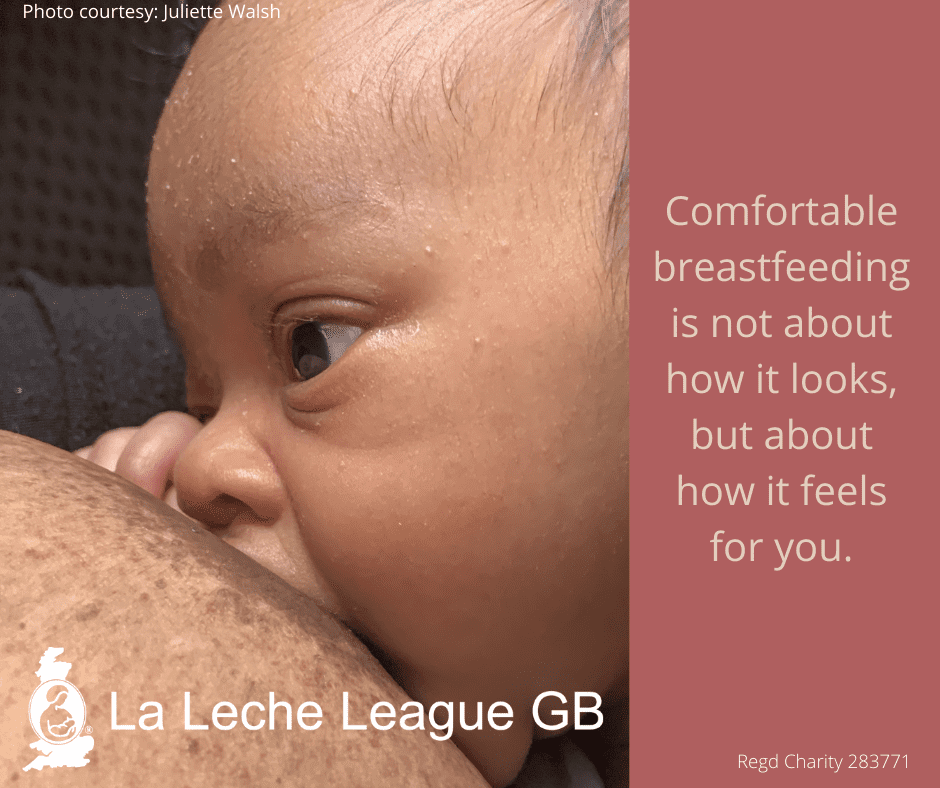
When breastfeeding is going smoothly, there is no need to worry about following rules or using a particular hold. If breastfeeding feels awkward, uncomfortable, or frustrating for either of you, it can help to understand a few basic principles and have some approaches to try.
Positioning and attachment are about how well breastfeeding works, not what it looks like.
If you are both comfortable and your baby is getting plenty of milk, then breastfeeding is going well for you – even if it looks unusual. Maybe you and your baby have invented your own feeding position!
Below we explore a few principles that can help if breastfeeding is not yet comfortable or effective.
What does deep attachment look like?

Our ancestors would have learned how to breastfeed from childhood, by watching many mothers nursing their babies. In the UK, many of us have never seen a baby nursing “close up” (or even at all) before we have our first baby. It’s not surprising that it can feel like a steep learning curve.
This video from clearly shows what deep attachment looks like and explains why it matters.
What are the signs of shallow attachment?
The difference between shallow and deep attachment may be only a millimetre or two—too small for even a skilled observer to see.
These signs indicate that it would be worth working on attachment:
- Your nipple feels pinched or rubbed during feeds
- When your baby comes off the breast, the tip of your nipple looks flattened, compressed, or lipstick-shaped
- The skin of your nipple feels sore or looks damaged
- Your baby makes a repeated ‘clicking’ sound while feeding, indicating loss of suction
- Your baby struggles to stay attached, repeatedly slipping off the breast
- Your baby often seems unhappy at the breast, or is not growing well just on your milk
If you don’t quickly manage to fix the issue yourself, there is lots of help available – you can contact your midwife, health visiting team, or a breastfeeding supporter such as a La Leche League Leader.
You can find more information about caring for sore nipples in our article on nipple pain.
How can I help my baby attach deeply?
There is a knack to helping your baby latch and it takes many of us a while to get the hang of it. The following principles may be helpful while you’re learning – feel free to take anything that works for you and leave the rest behind. Even a simple sequence of movement sounds complicated when you describe it, so don’t be put off by how many words it takes to describe something mothers and babies have been doing without instructions for millennia.
You can find latch basics in our Comfortable Breastfeeding article.
Start when your baby is calm
It’s easiest to practice positioning and attachment when your baby is calm and not too hungry. Offer the breast as soon as you see early feeding cues:
- Leg and arm movements
- hand-sucking
- lip-smacking
- head-turning, looking for the breast
If your baby is upset, take time to soothe them – hold them upright against you, stroke them and talk to them. A little expressed milk licked off the breast or given on a spoon can help calm a baby who is too hungry and frantic to latch.
Give your baby good support
When your baby has a stable base, they feel secure and can coordinate their movements well. There are lots of ways to give your baby good support:
- Laid back positions (see below) give your baby full body contact with you
- Side-lying positions (next to your baby in a safely prepared bed) place your baby on a firm mattress
- If you’re sitting up, snuggle your baby against you as firmly as if you were standing up holding them
Let your baby lead with their chin

To attach deeply, your baby needs to tip their head back and reach forward with their lower jaw, so they can anchor their chin and lower lip firmly against your breast. Think about how you would take a mouthful from a big sandwich by placing your lower jaw first then opening your mouth to fit in the top of the sandwich – the principle is the same.
Your baby’s lower jaw will be much further away from the nipple than their upper jaw. Your nipple will be nearer the top of their mouth, far towards the back. This is sometimes called an “asymmetric latch”.
When your baby comes to the breast chin-first, they can:
- open their mouth really wide
- swallow easily
- breathe comfortably
Allow your baby’s head to tilt back
Try swallowing with your chin tucked in towards your chest – you’ll quickly see why this is important.
Make sure nothing is pushing against the back of your baby’s head. This might feel strange at first, because newborns have relatively big, floppy heads that we are used to supporting. Placed face-down on your body, even newborn babies have impressive head and neck strength (see laid-back breastfeeding below). If you are sitting upright, you can support your baby’s neck and shoulders, allowing their head to move freely.
Touch on the back of their head confuses your hungry baby, who may try to “root” (turn) towards your hand. Trying to force a baby onto the breast by pushing the back of the head usually has the opposite effect and can even put a sensitive baby off breastfeeding.
Aim for a big mouthful of breast
Babies don’t nipple-feed – they breastfeed. This is why nipples of all shapes and sizes can work fine for breastfeeding.
If your baby tries to breastfeed just on the nipple:
- breastfeeding may be uncomfortable for you
- your nipple may be damaged by being squashed against the roof of your baby’s mouth
- your baby’s mouth compresses the milk ducts, preventing milk from flowing easily.
When a baby is deeply latched they take in a big mouthful of breast tissue and your nipple is drawn far back in their mouth, near the junction of the hard and soft palate. There is space back there, so your nipple won’t get squashed. Milk can flow freely from the ducts situated underneath your nipple.
How can I help my baby latch when my breast is very full or engorged?
It’s easier to get a big mouthful if the breast is soft. Think about a dog trying to grasp an over-inflated ball! Engorgement (breast swelling) is common in the first week after birth and can also happen at other times if you have an unusually long gap between feeds.
- Frequent breastfeeding helps to avoid engorgement and soften full breasts.
- For engorgement, try “reverse pressure softening”: apply gentle steady pressure with your fingertips around the base of your nipple for about a minute. You can also press with the sides of your thumbs or fingers. This moves fluid away from the base of the nipple. Making a small dent in the breast at the edge of the areola with a finger, then placing your baby’s chin in the dent, may also help.
- Gently hand express a little milk if needed.
You can find more ideas in our article Engorged Breasts – avoiding and treating.
Do I need to support my breast?
Some babies find it easier to latch if you support the breast with your hand to keep it firm and still. You may find you can let go once your baby has settled into the feed.
Let your breast rest at its natural level. It can be tempting to lift your breast and move it towards your baby’s mouth. If you do this, your baby probably won’t get a big mouthful, and after a while your hand may get tired and your breast may drop and slip out of your baby’s mouth.
If you have larger, softer breasts, you may find it easier to see what you’re doing if you give your breast a ‘lift’. You might like to try tucking a rolled-up muslin or towel under the breast, to lift it off your ribcage. If you find this helpful, you could secure your ‘roll’ with elastic bands so you don’t have to re-roll it every time.
Do I need a breastfeeding pillow?
Pillows and cushions aren’t always necessary and can get in the way, but they may be helpful, especially while you’re learning. A few babies seem to prefer the firm support of a pillow to being held in arms.
- Ordinary bed pillows, sofa cushions, rolled blankets and towels, etc. can work fine.
- One approach is to wait until after your baby’s latched on, and then tuck them under your arms and hands only if you need them for support – or prop up one or both feet and rest your arm on your knee instead.
- If you use a nursing pillow, make sure it’s not too high – your baby needs to be able to reach your breast at its natural level.
- Specialist breastfeeding pillows can be helpful for twins or more – to nurse both babies together, or keep one baby close while you nurse the other.
- If you have a single baby and a curved breastfeeding pillow, it may work best placed round your side, to support your arm on the side you’re nursing on. Or you could use it behind you, to support your lower back and arms.
- If you’re feeding side-lying in bed, you may find it comfortable to place pillows behind your back and between your knees. A long, curved pillow can do both at once. Always keep pillows well away from your baby in bed.
- If you’ve had a caesarean birth you can use a pillow, folded towel, or blanket to protect your incision.
More latch tips and tricks
Breast shaping
Some mothers find it helpful to shape the breast with their hand. Imagine it’s a big sandwich you’re offering to your baby – match the angle to the oval of their mouth. This can help your baby grasp more breast tissue.
It doesn’t matter if your fingers are closer to your baby’s upper jaw, but keep the “lower jaw fingers” out of your baby’s way.
The ‘exaggerated latch’ or ‘flipple’
To get an even deeper latch, try this optional extra
- Press your thumb or finger near the base of the nipple, where the middle of your baby’s upper lip will be, lined up with their nose.
- Your nipple will tilt away from your baby, presenting them with your breast rather than your nipple.
- As they open wide, snuggle them in close and use your thumb or finger to tuck the breast into their mouth. Your nipple will be taken in last and unroll in their mouth. You can then slip your finger out.
Watch this video to see how it’s done.
Your baby needs to choose their own timing
Your baby will probably do best if they pick the moment to latch on. You can help by putting them in a position that lets them try when they are ready. Skin-to-skin contact reminds your newborn that they need to feed. They may explore with their hands, nuzzle, and lick for several minutes before they are ready to latch. Rubbing a little expressed milk around your nipple can help encourage a sleepy newborn.
If your baby is very sleepy, you can find more information in our article Sleepy Baby – why and what to do. Check with your healthcare provider if you are worried about your baby.
Some babies need more time
Some babies find it difficult to latch on, or they nurse ineffectively at first. This may be more likely if:
- born prematurely, even if only a few weeks early
- small at birth
- affected by a difficult birth
- unwell
With time and patience, most babies will eventually breastfeed.
You can find gentle ideas to encourage your baby to breastfeed in our article My Baby Won’t Breastfeed.
In the meantime, expressing your milk for your baby gives you milk to feed them now and brings in a strong supply for the future.
Our article Getting Breastfeeding Back on Track after a Difficult Start may be a reassuring read if your baby is taking some time to start breastfeeding.
If nothing seems to be working, please reach out for support. Babies never choose not to breastfeed – there will be a reason why. Maybe your baby has a physical restriction which means that they just can’t open wide and attach well, however hard you both try. Our article on tongue tie has more information. La Leche League Leaders can help you decide whether specialist support is needed.
Most breastfeeding issues are fixable, with the right help. And if yours isn’t, we can help you find another way of feeding that works well for you and your baby.
Which breastfeeding positions can I use?
There is no single ‘correct’ breastfeeding position, but lots of options to try.
Remember: whichever position you use, the same principles apply:
- baby well supported
- chin leading
- head free to tilt back
- a big mouthful of breast
- comfort for both of you
Laid-back breastfeeding

What is it? You semi-recline (like on a sun lounger) with your baby lying face-down on your body.
Many people assume you have to sit up to breastfeed. In fact, laid-back breastfeeding (sometimes called natural breastfeeding or Biological Nurturing™) can make it easier for babies to use their feeding instincts and achieve a deep latch.
You may have used a laid-back position for your baby’s first feed after birth. It can continue to be helpful in the days, weeks, and months that follow. It can be done skin-to-skin or with both of you lightly dressed, in bed, on a sofa, or in a reclining chair. (Remember that it is not safe to fall asleep with a baby on a sofa or chair.)
How to do it:
- Recline comfortably so your body supports your baby’s weight.
- Place your baby against you, with their whole front in contact with your body. They can be vertical or at any comfortable angle.
- Your baby feels secure and can use their instinctive feeding reflexes to seek out the breast.
- Gravity helps keep your baby close and supports deep attachment.
- Your hands are free to help if you want to.
There are no rules about exactly how laid-back breastfeeding should look. The aim is simply to create a comfortable position where your baby feels well supported and can use their natural feeding instincts.
This video shows natural (laid-back) breastfeeding in action.
You can also use the same principles while sitting more upright by leaning back slightly and allowing your body to support more of your baby’s weight.
The “Koala Hold” is an example of a modified ‘laid-back’ position.
Other common breastfeeding positions and holds
Over the years, breastfeeding helpers have tried to find ways to help babies get a good latch, especially babies who may be sleepy or have post-birth complications. One approach has been to hold the baby in certain ways. When all is going well, specific holds and positions don’t really matter, because you and your baby figure out your own system. But if you’re having trouble, it can help to have a ‘recipe’ to follow until you know what works for you.
The Art of Breastfeeding, 9th edition (LLL International, 2024), p. 80.
Cradle hold

What is it? You sit up, baby across the front of your body, supported by the arm on the same side as the breast they’re feeding from.
This is one of the most common breastfeeding positions – it’s the classic one you often see in old paintings of nursing mothers. Once you’re confident with breastfeeding, you may find you use a version of the cradle hold much of the time, especially when out and about. You can give it a try at any stage.
How to do it:
- Sit up comfortably on a chair or sofa, in bed, or on the floor.
- Tuck your baby’s body firmly against yours.
- Your baby’s whole front is against your tummy, their hip resting on or near your thigh, tucked around you like a comma. Their chest will be snuggled into the breast and your nipple near their nose.
- Their head is resting on your forearm or wrist (not the crook of your elbow) on the side you’re nursing on. Your hand can support your baby’s back or bottom.
- As your baby opens their mouth to take the breast, pull their body in firmly against you with one or both hands.
- Once your baby is attached, settle back a little for your own comfort and so that more of their weight is taken by your body. You could rest your arm on a pillow or your crossed knee.
Cross-cradle hold

What is it? You sit up, baby across the front of your body, supported by the opposite hand to the breast they’re feeding from.
This cradle-hold variation can be useful in the early days because it gives you more control in guiding your baby to the breast. After the first few weeks and as your baby grows longer and heavier, you may prefer to use other holds.
How to do it:
- Sit up comfortably on a chair or sofa, in bed, or on the floor.
- Your baby’s whole front is against your tummy, their hip resting on or near your thigh, tucked around you like a comma. Their chest will be snuggled into the breast and your nipple near their nose.
- Your opposite hand supports their neck (not the back of the head) with your palm between their shoulder blades. The base of their head can rest on the “C” shape between your thumb and fingers.
- Your other hand is free to shape or stabilise your breast if needed.
- As your baby opens their mouth, push firmly with the palm of your hand to bring their chest in close against you. This plants their chin deeply on your breast.
- Once your baby is attached, you could support your arm with the one on the same side as the nursing breast (as shown in the picture), or take the top arm away, switching to a simple cradle hold.
Underarm (clutch, football, or rugby) hold
What is it? You sit up, baby beside you, their feet pointing to the back of your seat.

The underarm hold may be especially useful if you have had a caesarean birth, as it keeps the baby away from your incision. It can be a good position while you’re working on latch issues, because it offers you a good view of baby and breast and control of your baby’s head. You can also feed two babies at once in this position.
Most people need props (e.g. pillows) when feeding underarm, so it’s less useful when out and about, and tends to become impractical as babies grow longer.
How to do it:
- Sit up comfortably on a chair or sofa that has space for your baby next to you, or on the floor.
- You may want at least one or two pillows next to you, to support the weight of your arm and your baby.
- Your baby lies along your side, resting on your forearm, with your hand under their shoulders and neck. Your elbow keeps them tucked closely against your body.
- Your other hand can support your breast if needed.
- Your baby approaches your breast from below. If you have smaller breasts or a long back you may need to bring your baby into a semi-sitting position, or use extra pillows.
- You may need a cushion between your back and the chair back to allow room for your baby’s length and stop them pushing off the furniture with their feet.
Side-lying
What is it? You lie on your side on a safe surface. Your baby lies on their side facing you, their body tucked close to yours.

Side-lying breastfeeding is helpful if you are recovering from a caesarean birth or episiotomy and invaluable for nursing in bed for nights and naps. It can take a while to get the knack, but it’s well worth persisting because it can make night feeds so much easier. You might want to practise during the day, when you’re fully awake, can easily see what you’re doing, and maybe have someone to help.
Some mothers decide to sleep with their baby alongside them. Others choose to move their baby to a separate sleep surface.
You can find information about sleep safety in our article Safe Sleep and the Breastfed Baby and Further Reading, below.
How to do it:
- Prepare your bed in accordance with safe sleep guidelines.
- Lie on your side, with your knees bent up. You may want at least two pillows under your head and one behind your back. You might also be more comfortable with a pillow between your knees.
- If you have larger, softer breasts that tend to flatten, a folded towel or cloth under your breast (well away from your baby’s face) can raise it to the right height.
- Place your baby on their side facing you so that their body and your body form a V-shape, meeting at your hips, with your nipple level with their nose or eyes.
- Your lower arm can rest on the bed above your baby’s head. If you have smaller breasts you might need to support your baby on your arm to bring them up level with your breast.
- As your baby latches, you can use your free (top) hand to give a little push between their shoulder blades. This brings their chest in close and plants their chin firmly on your breast.
- Most mothers feed from the bottom breast (the one nearer the bed) and roll over to switch sides. If you have larger, softer breasts, or a baby who nurses very quickly, you might be able to feed from the top breast just by leaning over.
Standing up
What is it? You nurse your baby while you walk around, either in-arms or in a sling.

This is not the most comfortable way to breastfeed, but some babies seem to latch more easily on the move. You can sway or bounce gently to help calm them. Once your baby has settled into the feed, you might be able to sit down. Even when using other positions, sometimes just standing up and sitting down again straight away helps everything settle into a comfortable position.
If you have older children as well, nursing on the move might be an occasional necessity!
How to do it:
- As in any other position, snuggle your baby close and let them lead the way.
- Try angling their legs down instead of holding them horizontal, and see what happens. Or try starting with them against your shoulder, supporting them as they move down to the breast.
- It is possible to nurse in some types of sling or carrier, to take the weight off your arms. It is very important to follow safety guidelines if you nurse in a sling, including being able to see your baby at all times. New safety guidance on breastfeeding in slings is anticipated soon (summer 2026).
How does positioning and attachment change as my baby grows?
Whatever positions you breastfeed in, you will need to adjust how you hold and support your baby as they grow in length and weight. If breastfeeding ever starts to feel awkward or uncomfortable, a good first step is to go back to basic positioning and attachment principles, like the ones outlined above.
Around a month old is a common time to notice that breastfeeding has become uncomfortable, after a period of smooth feeding. The ‘newborn’ position you were using no longer works so well, now that your baby is bigger. The fix is often as simple as moving them a couple of centimetres backwards, lining them up nose-to-nipple again so they can still approach the breast chin-first. Or you might decide to explore some new, more ‘grown up’ positions.
Older babies and toddlers
You might be concerned about how breastfeeding will work when your child has teeth. It’s normal for mammal mothers to feed babies with teeth, and humans are no exception. The first two teeth to erupt are usually the bottom middle ones. These are covered by the baby’s tongue while breastfeeding, so don’t cause any trouble. Once your baby’s top front teeth have come through, encourage them to tip their head back while nursing, so they can’t press their teeth into the breast. Teething babies can sometimes be fussy feeders, or may try to ‘chew’ on your nipple, to relieve their discomfort. It can help to give them something cold and hard to chew on right before a feed. Once each new group of teeth is fully in, nursing usually settles down again.
You can find more information in our article on Breastfeeding and Teething.
Over time, getting your baby positioned and attached becomes much easier. Nursing a newborn takes concentration and precision. As they gain experience, and grow in size relative to your breast, breastfeeding becomes second nature to both of you. Older babies and toddlers can sometimes become very creative with their nursing positions, which can bring its own challenges! If a breastfeeding behaviour is annoying you or causing you discomfort, it is fine to pause the feed, show your baby what to do, and offer again.
You can find more information about breastfeeding in the second year and beyond in our articles Still Nursing? and Thinking of Weaning?
La Leche League meetings can be good places to watch babies of all ages nursing in all kinds of positions, and you’re always welcome to contact us for one-to-one support. Whatever stage you’re at, and however breastfeeding is going for you, we’re here to help.
Written by Sue Upstone, Karen Butler and mothers of LLLGB
Updated by Jayne Joyce, May 2026
If this article has helped you, please consider supporting LLLGB with a donation. Every gift, however small, helps keep breastfeeding information and support flowing.
Further Reading
Breastfeeding Essentials
Caesarean Birth & Breastfeeding
Comfortable Breastfeeding: Essentials
Engorged Breasts – Avoiding & Treating
Getting Breastfeeding Back on Track after a Difficult Start
Hand Expression of Breastmilk
Inverted Nipples
My Baby Needs More Milk
My Baby Won’t Breastfeed
Nipple Pain
Safe Sleep & the Breastfed Baby
Sleepy Baby – Why & What To Do
Videos
Newborn Nursing video collection (La Leche League Canada)
Breastfeeding videos in multiple languages (Global Health Media)
Natural (laid-back) breastfeeding (Nancy Mohrbacher)
Books
The Art of Breastfeeding, 9th edition. LLLI. London: Pinter & Martin, 2024. Chapter 4, Latching and Attaching.
Breastfeeding Answers: A Guide to Helping Families, by Nancy Mohrbacher (2020). Chapter 1, Basic Nursing Dynamics, Chapter 3, Latching and Nursing Struggles.
Supporting Sucking Skills in Breastfeeding Infants, 4th edition, by Catherine Watson Genna (Jones and Bartlett, 2022)
An Introduction to Biological Nurturing; New angles on breastfeeding, by Suzanne Colson (Amarillo, TX: Hale Publishing, 2010).
Copyright LLLGB 2016, 2026