
If you have sore nipples, painful breastfeeding, are struggling with positioning, or wonder whether your baby has a good latch, you’re not alone. It can take a few weeks for breastfeeding to feel completely comfortable and easy, even if you’ve breastfed before. Small adjustments can make breastfeeding much more comfortable, so don’t be afraid to experiment.
This article covers the basics of how positioning and attachment work, how to help your baby latch deeply, and what to do if breastfeeding still hurts.
If you’d like a deeper understanding of breastfeeding positions, attachment, and how babies remove milk from the breast, see our article on Positioning and Attachment.
Summary
- It can take time and practice for breastfeeding to become completely comfortable.
- It’s worth taking time to get yourself really comfortable before you position your baby.
- Babies feed best when they can use their natural feeding instincts.
- A deep latch makes feeding comfortable and enables your baby to remove milk effectively.
- Small adjustments can make a big difference.
- If breastfeeding is not becoming more comfortable, get help quickly.
On this page
How can I get breastfeeding off to a comfortable start?
Breastfeed early and often after birth. Frequent feeding helps your baby practise breastfeeding and can minimise engorgement (uncomfortably full breasts) when your milk production increases.
If feeding hurts, don’t wait for it to improve by itself — seek support early. Small changes to positioning and attachment, and good help, can make a big difference.
How do I position (hold) my baby for breastfeeding?
There’s no single “correct” position for breastfeeding. You can find some ideas to try in our full article on Positioning and Attachment.
Here are some tips to get you started:
- Skin-to-skin contact gives your baby easy access to the breast and encourages their inborn feeding reflexes.
- Find a comfortable position where you feel well supported: lying back, sitting, or lying down.
- Pillows and other props can be helpful to support your back, arms, or feet.
- Relax comfortably with your breast in its natural position.
- Hold your baby close so their whole body fits snugly against yours.
- Check their head is in line with their body, not turned to one side.
- Make sure your baby can tip their head back freely. You can support their shoulders, if needed.

How can I help my baby get a deep latch?
Your baby is born with strong feeding instincts that help them find the breast, latch, and suck. Placed skin-to-skin on your chest, you might find that your baby makes their own way to the breast and latches with little or no assistance.
It make take practice before this works smoothly every time, and it’s fine to help your baby.
These tips may help:
- Offer the breast before your baby is really hungry, if you can. A calm baby has more patience.
- Let your baby touch the breast. The feel of the breast against their hands and face prepares your baby to latch. They may start to move their head and open their mouth.
- Think ‘nose to nipple’. Line your baby up with the nipple near their nose, to help them open wide.
- Bring baby to breast, not breast to baby.
The mnemonic ‘CHINS’ may be helpful.
C = close: Your baby is held close against your body.
H = head: Your baby’s head is tilted back.
I = In line: Your baby’s body is in a straight line.
N= Nose to nipple: You start by lining your baby up with their nose (not their lips) near your nipple. This encourages them to open wide and contact the breast chin-first, head tipped back.
S = sustainable. You’re in a comfortable position you can stay in for the whole feed.

Why is a deep latch important?
Babies breastfeed — they don’t nipple-feed. When your baby has a big mouthful of breast, breastfeeding is more comfortable for you, and your baby can get more milk.
This video explains why deep attachment is important, and shows you how to do it.
Things to remember:
- To open wide, your baby needs to be able to tip their head back.
- Your baby contacts the breast chin-first.
- Their lower jaw will be tucked into your breast, well away from the base of your nipple.
- Their nose will be free.
- Your nipple will be drawn towards the back of your baby’s mouth where it’s comfortable for you and works well for your baby.
Do I need to hold my breast during a feed?
Breastfeeding is often easier if the breast rests at its natural level. If you lift it into your baby’s mouth, they are unlikely get a deep mouthful.
It can be helpful to support the breast to make it a stable ‘target’ for your baby to latch onto. If supporting it with your hand, keep your fingers well back from where your baby’s chin will be. Shaping your breast slightly to match the oval of their mouth can help. Once your baby has latched and settled into the feed, you might be able to let go of your breast.

Which breastfeeding positions work best?
“Laid-back” (also known as “natural”) breastfeeding positions can be very helpful when you’re both learning, because:
- your baby can use their hands and feet to help them find the breast and latch on.
- the weight of your baby is supported by your body, leaving your arms and hands free to help if you want to.
- you can rest and relax while you feed your baby.
Watch a video about laid-back breastfeeding.
How can I tell if my baby has a deep latch?
Here are some things to look for. Your partner or supporter may be able to see more easily than you can:
- Your baby’s chin is pressed firmly into the breast.
- Your baby’s mouth is open very wide, like a yawn (not narrow, like sucking noodles)
- Your baby’s nose is not pressed into the breast. It might gently touch, or there might be a gap.
- Your baby has full, rounded cheeks.
- Your baby starts doing deep sucks. You might be able to hear a swallow after every one or two sucks, or feel a slight pause as your baby swallows.
- Your nipple does not feel pinched or rubbed.
- Your nipple looks rounded (not pinched, creased, or lipstick-shaped) when your baby comes off the breast.

What if breastfeeding hurts?
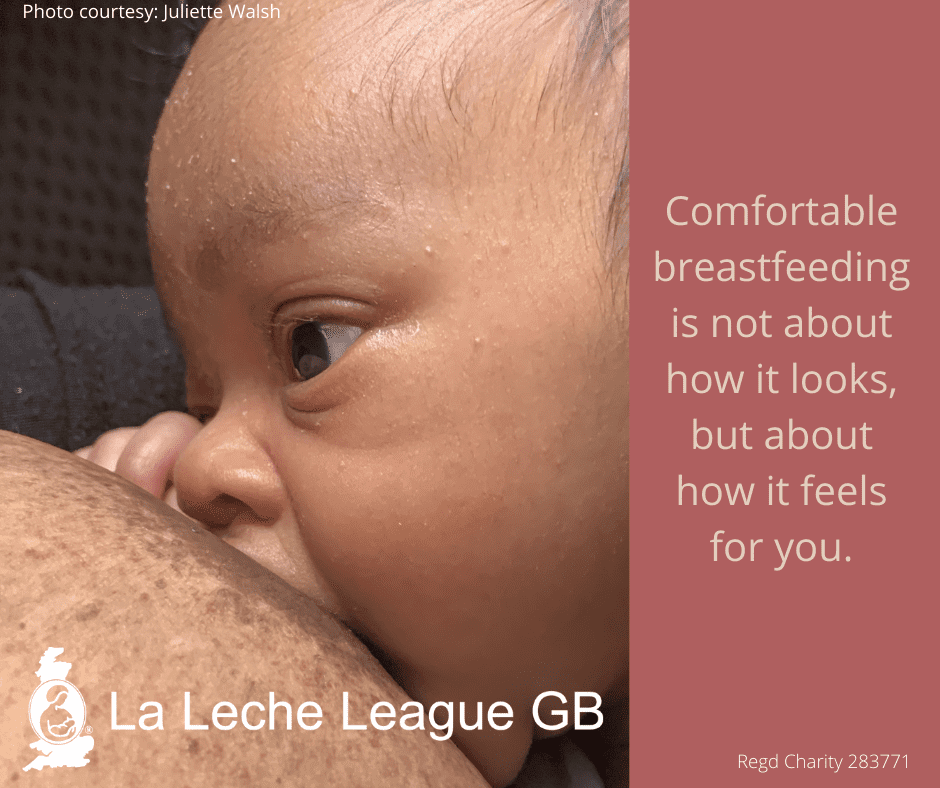
How breastfeeding feels is much more important than what it looks like. If it’s painful — even if someone tells you it looks good — something needs to change.
Pain is not something you have to just put up with. Nipple don’t “toughen up” through ongoing pain. Instead, mothers and babies find ways of making breastfeeding more comfortable. With small adjustments, and support if you need it, breastfeeding usually becomes more comfortable as you and your baby gain experience.
You can find more information in our articles on nipple pain and positioning and attachment.
Make adjustments
It’s often possible to help your baby attach more deeply without needing to take them off:
- move your baby a bit backwards, towards their feet, then
- snuggle your baby’s bottom and shoulders more closely towards you.
This brings your baby’s chin into closer contact with the breast and helps them open wider, taking in more breast tissue.
You can see a video of how to do this here.
If this doesn’t help, you will need to take your baby off and try again. Insert your clean little finger into the corner of their mouth to pop them off gently.
Get help
There is lots of assistance available as you and your baby learn to breastfeed. Getting help early can prevent small problems becoming bigger ones. Your midwife, health visiting team, and local breastfeeding supporters, such as La Leche League Leaders, are all here to help.
La Leche League meetings enable you to find support and encouragement from other mothers, and learn by watching how they hold and latch their babies.
Written by Sue Upstone, Amanda Dunbar and mothers of LLLGB.
Updated by Jayne Joyce, May 2026
With thanks to Lois Rowlands, Suzanne Tobin, and others who have kindly allowed us to use their photos.
If this article has helped you, please consider supporting LLLGB with a donation. Every gift, however small, helps keep breastfeeding information and support flowing.
Further Reading
Positioning and Latch (LLL International)
Getting breastfeeding back on track after a difficult start – the three keeps
Books
The Art of Breastfeeding, 9th edition (La Leche League International, 2024). Chapter 4, Latching and Attaching
Videos
Newborn Nursing series (La Leche League Canada)
Breastfeeding videos in multiple languages (Global Health Media)
Natural (laid-back) breastfeeding (Nancy Mohrbacher)
Copyright LLLGB 2016, 2026.